Ignored to Exploited: The Menopause Industry
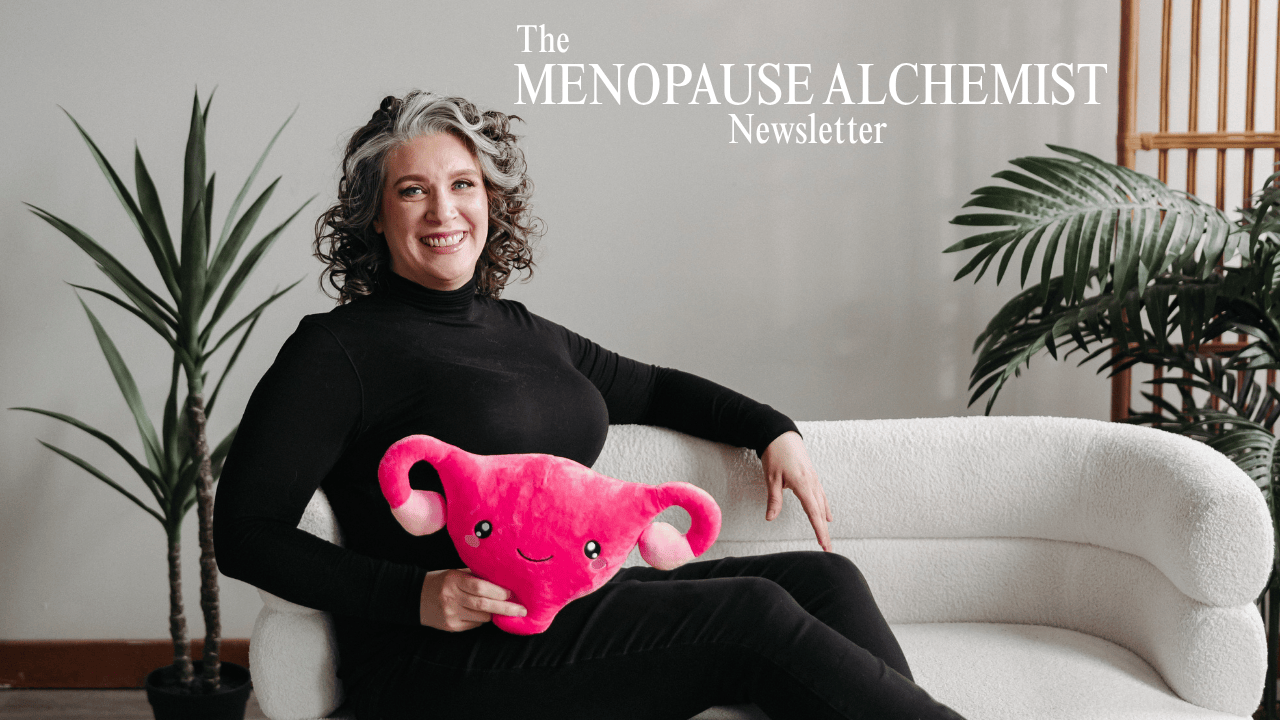
Apr 15, 2026Welcome to the first episode of the Menopause Alchemist podcast. Before we dive into today's topic on the menopause industry, got a few housekeeping items to go over. First of all, this is actually a video presentation, so if you're listening to this as a podcast, you can pop on over to my YouTube channel and watch the full presentation there.
Conversely. If you're already watching this on YouTube, you can certainly listen to it on any of the major podcast platforms. Just search for the Menopause Alchemist. Likewise, transcripts can be found on my blog, along with some additional reading links and the source that I use to actually create this presentation. As always, links will be in the show notes.
So who am I? I am Coach Kristy Lynn, and I'm a certified health and wellness coach, with specialty certifications in women's health and menopause. I'm also a certified nutrition coach, and at the time of this recording, I'm [00:01:00] currently in Schrodinger's Menopause, meaning I am on day 331 of my 365 day countdown. I am also the founder of Beautiful Life Fitness and your host of the Menopause Alchemist podcast.
Okie dokie. Let's get talking about the menopause industry and how it seems we may have gone from ignored to exploited.
$17.8 billion. That's how much the menopause industry was worth in 2024. If that holds. We're projected to hit $24.3 billion by 2030.
Remember when menopause was something nobody talked about, or when women were suffering in silence, or if they did say anything, they were told it was all in their heads and just handed some antidepressants and told to just deal with it.
Fortunately, those days are coming to an end, but before we pop the champagne and celebrate, let's talk about what's [00:02:00] replacing that. A multi-billion dollar industry. So the question becomes are we better off or are we just going from ignored to exploited?
So what are we gonna cover today? We're gonna look at the size of the industry, the revenue generation, regulation, or lack thereof. We'll look at the good, the bad, and the ugly, progress, as well as what got us into this mess and what we have to deal with now and we'll look at how you can protect yourself, and your wallet by looking at red flags and green flags for providers, supplements, and some overall good practices to protect yourself.
So let's get started with the industry numbers. 12% of the global population is in menopause. That is over 1 billion in menopause.
6,000 enter menopause every day in the United States alone and [00:03:00] of those in menopause, 90% will experience symptoms that negatively impact their day-to-day lives. Whether that's work, their home life, their sex life, their finances, the whole nine yards. There isn't an area of their life that it does not touch.
And that 17.8 billion that I mentioned before, the US alone accounts for 83.5% of that. That's just under $15 billion. Dietary supplements are 94% of the revenue share, which is a little under $17 billion. And again, we're projected to reach that 24.3 billion by 2030, but it's not just the United States that is growing for the revenue here. Canada is close on our heels. They are actually anticipated to register the fastest growth during this period of 2025 to 2030.
That's a whole lot of money for an industry that is [00:04:00] largely unregulated.
We've all heard of hormone replacement therapy now usually called menopause hormone therapy. There's also a whole bunch of non-hormonal therapies that are coming onto the market and these are all FDA regulated, meaning they have to have clinical trials and we've gotta have prescriptions from our doctors to get them. These are legit treatments to help with the symptoms of menopause and the menopause transition.
Then we've got dietary supplements. Now, dietary supplements have always been the wild, wild west. Like they, they've never had good regulation and it's always a hit or miss. I use a melatonin supplement and the one that I was using for approximately six to nine months was doing absolutely nothing. And so I switched because I found one that was actually cheaper. And that one works really well. My dosage was actually cut in half because I was actually getting the proper dosage of medication now. And, coincidentally not too long after I made the switch, I found a writeup on a whole [00:05:00] bunch of different, over the counter dietary supplements that actually are fake. There's really nothing in them.
But these over the counter pharma products and these dietary supplements, they're not going anywhere. They're going to significantly expand in the coming years. We already see things like topical progesterone, topical estrogen, DHEA, melatonin. We already see a whole lot of these things on the market now, and that's only going to get bigger, particularly because there is nothing stopping them from doing it.
It used to be where if you wanted hormone therapy you had to go to your doctor. Now you don't. You can treat yourself from home and consequences be damned.
But how did we get here? And this can't be all doom and gloom. Right. Well let's take a look at the bad first because it's important for us to understand how we got here. You know, doctors love to blame us for doing our own research.
They make snide comments or they make TikTok videos about how people are treating themselves based [00:06:00] off of what they see online. And you know, they're not wrong. We do that. But why? You know, the harsh reality is, is we wouldn't be here if y'all as a profession gotten your shit together a long time ago and were properly treating us.
So, I mean, when we look at it, 92% of OB GYN programs lack a menopause curriculum. My personal GYN, she never took a single class during her entire medical school on menopause. Not a single class. She said maybe she had a week or two in one of her classes that mentioned menopause, but she didn't have anything on treatment options, symptoms, signs, how to deal with it through medications or how to deal with it with non-hormonal medications. She didn't get any of that education.
By law researchers weren't even required to include women in studies until 1993. It wasn't even recommended to include women in research until 1989. [00:07:00] So overall, the vast majority of menopause funding is not really going to research and it never really has. It's still going towards supplements and those aren't regulated.
So again, you know, when we do our own research, it's kind of, 'cause we've always had to. For decades menopause has been treated like a dirty little secret. We all know that. You know, the medical community largely ignored it. Society pretended it didn't exist and we were invisible because our worth was tied to our fertility and once that ship sailed, so did our relevance.
But. It's not all bad. Attitudes are changing. If you are just entering the menopause transition now, it's going to look considerably different than previous generations. Even your older sister is gonna have a different experience than you.
This is legitimate progress, regardless of the ulterior motives that the market might have for finally addressing this issue and this lack of care. [00:08:00] Fortunately, we are now developing a community. There's open discussion in mainstream media, workplaces, social services. There's even state legislation starting to come through.
I believe it was Connecticut I saw earlier this year. Maybe it was Vermont, but one of those states that they're starting to pass legislation now at the state level to protect those who have to take time off for menopause symptoms. So we are actually starting to develop a community now. It's not something that is hidden in the shadows, in shame. Employers are even starting to offer menopause benefits. So there, it's not all doom and gloom in that respect. We do have some things that are getting better.
Likewise, research funding specific to menopause and the menopause transition is actually growing. It's not growing as much as it needs to to catch up from how badly it's been ignored, but we need all that research. We need more hormonal and non-hormonal treatment options.[00:09:00]
And all of this has actually produced some products that actually do work. We have better menopause hormone therapy options. It's not just oral medications anymore. We've got gels, we've got patches, we've got implants, we've got injectables. We've got more options than any generation prior to us has ever had, including non-hormonal options.
Before it used to be if you had a history of breast cancer or if you had a high risk of breast cancer, you were just SOL, right? Like shit outta luck. Sorry. So there are products that are coming up that actually do work and are actually helping people every single day. For the first time in history, we aren't expected to suffer in silence, but.
Unfortunately this has led to marketing over medicine. The pink tax is getting an upgrade. We're seeing that existing beauty [00:10:00] products that have been around for years are getting some new packaging that say menopause solutions or for the menopausal and they're marking it up 30 to 50%. And of course insurance doesn't cover any of this. Even menopause hormone therapy is actually difficult to getting covered by insurance. So none of these other over the counter options are being covered by insurance and they're being marked up and the vast majority of them might not even be any different than any of the other products that have been out there for years that were previously just marketed as mature or for aging, things like that.
We've also got influencers and we've got venture capitalists who have now rebranded themselves as private equity. We've got affiliates and these are all profit driven people. The influencer economy is why we've got plucky 25 year olds talking about their wrinkle cream that they use. Like they don't use wrinkle cream. They're 25, right? But they are paid to [00:11:00] promote this product, so they're gonna promote that product. That's what they do.
We've got venture capitalists, again, rebranding themselves as private equity, which are mostly just men in boardrooms that realize that there is a massive untapped market opportunity here, and instead of doing the right thing, they're doing the most profitable thing.
And affiliates, same thing. That's why we've got chiropractors out here who their specialty is the musculoskeletal system, and they're out here talking about which progesterone and estrogen you should be taking, right? Like they are recommending things so far out of their scope of practice, but they can get away with it because they're just affiliates. They're not actually the ones doing the prescribe or anything like that. They're just recommending it because it's an affiliate link.
But again, all of these are profit driven. This isn't about patient outcomes. This isn't about making you feel better. This is about [00:12:00] padding the bottom line and that lack of regulation on these products, doesn't help the situation at all.
I'm a certified coach, but the majority of coaches you see out there don't actually have any formalized training, nor do they have training from an actual accredited agency. But it doesn't really matter. They don't need to. There's no national system. Doctors have to go through licensing, registered dieticians have to be licensed in most states. But coaching doesn't have any of that. You are basically relying on their integrity to bring you proper information and do what's in your best interest.
And of course there's still the age old issue of messaging. The messaging is still obsessed with youth and quick fixes and cures. Here's the hard truth y'all. We are aging. Period. We can't cure menopause. We can't cure aging, and [00:13:00] it's sad how much time, energy, and resources are actually spent on a losing battle. We are never, ever going to be younger than we are right now in this second. Doesn't matter how many supplements we take, we are still aging, period.
Again, the messaging is problematic along with the lack of regulation.
What can you do? What can you do to protect yourself, your health, and your wallet?
When selecting a provider, first thing to look at is to check their website. Do they have a real website or is it just a social media page? If they don't have a proper website, that is a gigantic red flag.
Likewise, take a look at that website. What is front and center, the first thing you see when you start scrolling down, is a popup that tells you about all their supplements for sale or their promotion that's going on. And is the messaging about themselves or is it about you?
For example, I've seen a doctor who was a functional [00:14:00] medicine doctor and all she talks about is the millions of dollars that she's made. And I don't care if you've made a million dollars. I want to know if you can actually help me. If they're talking about money and how cheap their supplements are, huge red flag.
And finally, let's also take a look at their about page. Does it have actual information about the company, the founders, their credentials, their philosophy, what, what's on there? Does it actually have more information about them? Actually read that about page. If it sounds like chat, JP chat j, chat G blah. Claude, we're gonna go with Claude. If Claude wrote it. Then again, be wary. It's not actually that hard to create a website. So again, read it and make sure that it actually sounds like there's a human behind it. And if you can't find the credentials or the agencies that awarded them, again, another red flag.
For example, if you go to my website. You can go to my about page and from my about page. You can click from there to my credential [00:15:00] page that also has my philosophy and so forth. On my credentials, you can click on the picture of each of those agencies and it'll take you right to that agency's homepage. So you can look for yourself to see that these are agencies that are accredited and real, number one, and that I do actually have the training that I say I have.
And then the last thing is their personal experience. So now I'm not saying, that somebody who has never been through menopause or somebody who never will go through the menopause transition can't help you.
I'm not saying that, however, I am saying that somebody who has been through it or is even currently going through it themselves has a different level of understanding than somebody who's only read about it in a book.
I, 10 years ago, I had absolutely [00:16:00] no clue. Partially because nobody told me, but also because I was young, I didn't have to think about it. I was not faced with the changes that came about with perimenopause, so it never even entered my mind.
Okay, so what about when we're looking at supplements? Same thing goes here as it goes for any supplement. Check for that third party testing. Avoid anything that has proprietary blends. If it just says a proprietary blend of, no, no, that's, that's again, sus. If I'm going to put that into my body on a regular basis, I need to know what's in it. But, with any supplement, always consult your doctor, a registered dietician and/or your pharmacist first.
Don't start taking anything before you know it's safe to do so, especially if you are on medications for any other kind of medical condition. So, I mean, even something such as vitamin D is, is not benign. Right, and you can have a blood test [00:17:00] to tell you if you actually really need to take vitamin D or not.
So again, any supplement, make sure you talk to your doctor, a registered dietician or your pharmacist first before you start it. And when you do actually start it, if they give you the on clear, make sure that it's actually from a reputable company that has third party testing and is transparent with their ingredients.
All right. Overall, menopause hormone therapy is legit, right? The prescriptions that you get from your doctor, those are legitimate treatments. Whether they are hormonal or not makes no difference, but they are not a fountain of youth. They are going to help you manage your symptoms, but they are not going to turn back the hands of time.
You are getting older, period. There is nothing wrong with that either. Just because you're aging doesn't mean that you are irrelevant. Doesn't mean that you don't matter. Doesn't mean you don't have something to give the world.
And maybe it's time we start saying, what would [00:18:00] happen if I embraced this era versus chasing after my youth and spending all this time, money, and energy on chasing something that I'm never gonna get back.
Likewise, perimenopause has taken the blame for a lot of things. In one of my Facebook groups I found a post from a person was having some tachycardia and some heart palpitations, and everyone in the comments told her. " Oh, that's just perimenopause. You're fine". And yeah, there's a really good chance that it probably was only a symptom of perimenopause, but never assume that. Never ever, ever, ever, ever assume that what you are experiencing is just because of perimenopause.
Go talk to your doctor, have them run some tests. I had a lot of leg pain for a while there, and again, same thing. Everyone was like, "oh, it's probably just perimenopause". And you know what, it wasn't. I have two venous insufficiencies, one in each leg, so I now have to wear compression socks every [00:19:00] day. And those compression socks may not prevent me from ever needing surgery. But they're going to significantly delay that need for surgery. And if I wouldn't have caught it now, if I would've just blown it off as something with perimenopause, there's absolutely no way I would've been able to avoid surgery.
So again, overall, do not just pass things off as perimenopause. Go to the doctor and have it checked out.
Okay. So add to the end of the day, what are we saying here?
The existence of the menopause industry is not the problem. The problem is that it emerged from a vacuum created by decades of medical neglect. And as such, we are now seeing a massive market opportunity that companies are exploiting.
We deserve better. We deserved evidence-based care that's accessible and affordable. We deserve doctors who are properly trained in menopause medicine. We deserve research funding that matches the scale of the problem. [00:20:00] So until we have all those things, the menopause industry will continue to thrive and it will continue to be a mixed bag of genuinely helpful innovation and opportunistic exploitation.
Visibility is progress, but visibility, driven by profit, not patient outcomes, has some pretty significant strings attached to it. So do your due diligence, ask questions, be skeptical, demand evidence, and remember that the most valuable resource you have is free your ability to think critically.
All right. Well, thank you for being here for my inaugural episode of the Menopause Alchemist podcast. And just as a reminder, you can listen to this on any major podcast platform, or you can watch the presentation on my YouTube channel and the transcript is available, my blog post, which I'll have that link in the show notes.
All right folks. That's it for this episode. Stay tuned for next week's Embracing Your Elder Era episode, and don't forget to rate, follow, [00:21:00] and subscribe.